Collection: Socket Testers

Not sure whether a wall socket is actually earthed? A tester plugs in and tells you in a second or two. Read the guide to testing a wall socket to see how to read one on a Type F, Type G or Type A/B outlet.
Verify Your Earth Before You Ground
A grounding product has nothing to connect to unless the wall socket it plugs into has a functioning earth connection. Our socket testers are simple plug-in devices — no batteries required — that instantly verify whether your socket is correctly wired. Just plug in and read the LED pattern: green means you're ready to ground; a fault indicator means you should switch sockets or consult an electrician before use.
Grounding products connect through a cord with a built-in ≈91 kΩ ±1% current-limiting safety resistor. However, without a valid earth, any grounding product you connect afterward has no effective path to the earth. Testing takes under five seconds and eliminates guesswork entirely.
Available Testers by Region
- UK (Type G): For all standard 3-pin British sockets.
- Europe / Schuko (Type C/F): For standard Schuko outlets across Continental Europe.
- India (Type D): For Indian standard 3-pin sockets.
- Israel (Type H): For Israeli standard sockets.
- Australasia (Type I): For Australia, New Zealand, and China.
- Switzerland / Italy / Brazil (Types J, L, N): 2-in-1 device — fits regional sockets and converts to a Schuko tester by removing the front adapter. 220–240 V only.
- Denmark (Type K): For Danish standard sockets.
- South Africa (Type M/N): For South African standard sockets.
- North America (Type A/B): For US and Canadian 3-prong outlets.
-
Type C/F Socket Tester - Europe
Regular price €29,00 EURRegular price -
Grounding Tester Pen
Regular price €9,00 EURRegular price -
Type H Socket Tester - Israel
Regular price €29,00 EURRegular price -
Type A/B Socket Tester - North America
Regular price €29,00 EURRegular price -
Type I Socket Tester - Australasia
Regular price €29,00 EURRegular price -
Type M/N Socket Tester - South Africa
Regular price €29,00 EURRegular price -
Type D Socket Tester - India
Regular price €29,00 EURRegular price -
Type K Socket Tester - Denmark
Regular price €29,00 EURRegular price -
Type J/L/N Socket Tester
Regular price €29,00 EURRegular price -
Type G Socket Tester - UK
Regular price €29,00 EURRegular price




Common Questions About Socket Testers
What does a socket tester tell me?
It compares the three conductors in a wall outlet and lights a pattern you read against the legend printed on its body. That pattern distinguishes correct wiring from a missing earth, from live and neutral reversed, and from similar faults.
What can a socket tester not tell me?
It is a wiring check, not a measurement: it gives no earth-resistance figure and cannot see the circuit behind the outlet. It also cannot detect a bootleg ground — an earth terminal bonded to neutral — because that reads as correctly wired.
Which socket tester do I need?
The one that matches your outlet type. The list above gives the tester for each region, and every product page states the plug type it fits. Check the outlet you actually intend to use, since sockets can differ within one building.
What should I do if the tester shows no earth?
Do not use that outlet for a grounding connection. Test the other outlets in the property, or use a ground rod outside instead. A missing or incorrectly wired earth is worth raising with a qualified electrician regardless of grounding.
Is the Grounding Tester Pen the same thing?
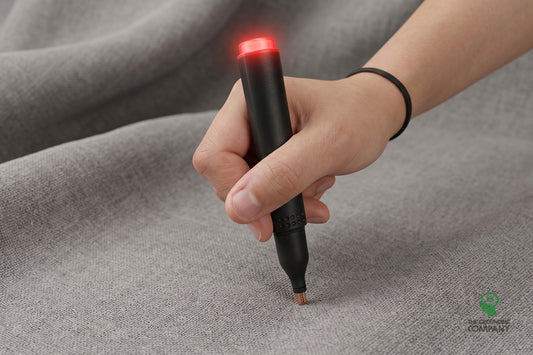
No, it answers a different question. A socket tester checks the wall outlet’s wiring; the Grounding Tester Pen reads whether the fabric conducts between the two copper pins in its tip, at the point you touch it. It does not test the socket, the cord or the snap connector, and it lights whether or not the cord is plugged in. Many people use both.
Do these testers need batteries?
The plug-in socket testers draw what they need from the outlet, so they take no batteries and nothing to replace. The Grounding Tester Pen is the exception: it runs on a CR1220 coin cell, which is included.